
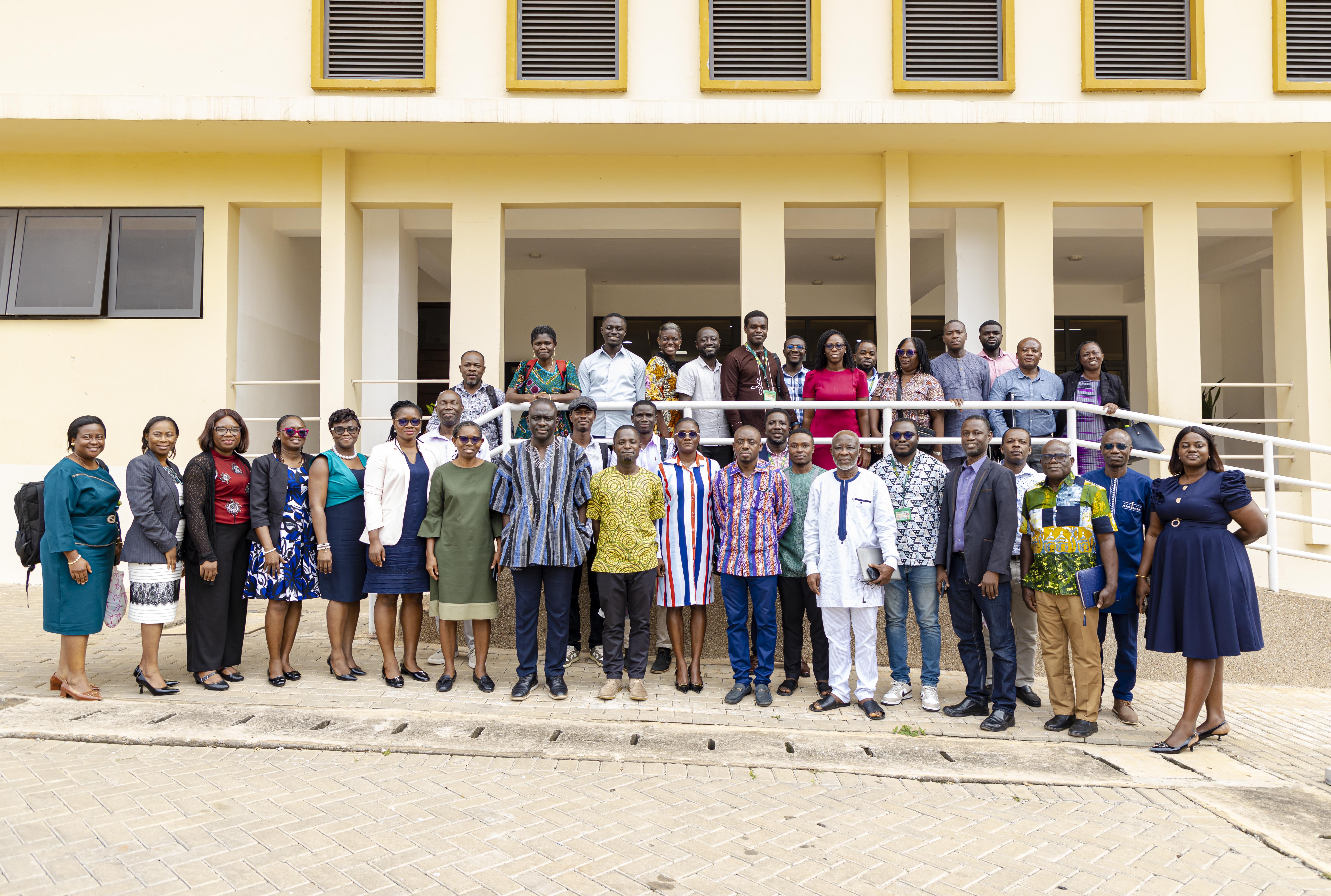
The Journal of Science and Technology (JUST) of the Kwame Nkrumah University of Science and Technology, Kumasi (KNUST), with support from Electronic Information for Libraries (EIFL), has organised a capacity-building workshop for journal reviewers to strengthen peer review practices and improve the quality of scholarly publications.
The workshop, organised under the JUST-EIFL Project, brought together reviewers, editors, faculty representatives and stakeholders in scholarly publishing to strengthen editorial processes. It focused on the Open Journal Systems (OJS) platform, manuscript evaluation, research integrity, peer review ethics and the effective management of review assignments.

Welcoming participants, the Editor-in-Chief of JUST, Professor Yaw Adu-Sarkodie, highlighted the importance of strengthening the capacity of reviewers and editors to maintain high standards in academic publishing.
He said JUST, established in 1988, has evolved into a multidisciplinary journal publishing research from KNUST, Ghana and institutions around the world, covering science, health sciences, mathematics and the humanities.
"This workshop is aimed at equipping reviewers, editors, and faculty representatives with the knowledge and skills needed to support the journal's editorial and publication processes," he said.
Professor Adu-Sarkodie said the journal operates on a 12-week publication cycle involving peer review, revisions, editorial decisions and production. It currently publishes four issues a year using an online-first model, under which articles receive Digital Object Identifiers (DOIs) before appearing in print.
He added that JUST receives submissions from Ghana and other countries, including Nigeria and the United Kingdom, and has published about 1,000 manuscripts. He said the journal is indexed on African Journals Online (AJOL) and is working towards inclusion in international databases such as Scopus and the Directory of Open Access Journals (DOAJ).

The University Librarian, Dr Richard Bruce Lamptey, said journals must meet international standards in editorial quality, publishing practices, metadata management and technical requirements before they can be hosted on major platforms or indexed in global databases.
He said the University's publishing support initiatives would focus on strengthening peer review systems, improving publication ethics, ensuring quality metadata, supporting DOI registration through Crossref and promoting the use of persistent identifiers and XML metadata.
"The goal is to ensure that KNUST journals meet international publishing standards and improve their visibility, accessibility, and impact globally," he said.

The Deputy Librarian, Dr Edward Mensah Borteye, discussed scholarly publishing, open access and the role of reviewers, highlighting the importance of peer review in maintaining research quality and credibility.
He said scholarly publishing involves a structured process from research development and manuscript preparation to editorial screening, peer review and publication, while encouraging researchers to uphold honesty, transparency and accountability.
"Peer review remains a critical process for assessing originality, accuracy, methodology, and ethical standards to ensure that published research contributes reliable knowledge," he said.
Professor (Mrs.) Ibok Oduro, an Editor of JUST, spoke on ethics and integrity in peer review and writing effective reviewer reports. She emphasised confidentiality, objectivity, professionalism and the need for reviewers to provide constructive, evidence-based feedback.
She encouraged reviewers to regard manuscript rejection as part of the academic publishing process and an opportunity for improvement rather than failure.
"Reviewers must uphold ethical standards and provide fair, objective, and constructive comments that help improve the quality of research," she said.
The Head of the Department of English, Professor Confidence Sanka, discussed proofreading and reviewing academic manuscripts, distinguishing between proofreading, which focuses on language accuracy, and reviewing, which evaluates clarity, coherence, logic and the overall quality of research.
He encouraged authors to prioritise clear academic communication, strong manuscript structure, evidence-based arguments and consistency in language and formatting.

Dr (Mrs.) Lucy A. Ry-Kottoh of the Department of Publishing Studies urged researchers to carefully select credible journals, follow publication guidelines and avoid unethical practices such as plagiarism, data falsification, duplicate publication and conflicts of interest.
She emphasised that researchers should verify the credibility of journals and maintain integrity throughout the publication process, from manuscript preparation to post-publication corrections.
"Peer review improves the quality of research, but it does not replace the responsibility of authors and researchers to uphold honesty and ethical standards," she said.

Mr Godwyll Agyare, Principal ICT Assistant at the University Information Technology Services (UITS), provided hands-on training on the Open Journal Systems (OJS) platform and the peer review management process.
Participants were taken through reviewer registration, manuscript assignment, accepting or declining review requests, evaluating manuscripts, submitting recommendations and communicating with editors through the platform.
Story: Ama Pokuaa Mensah


